

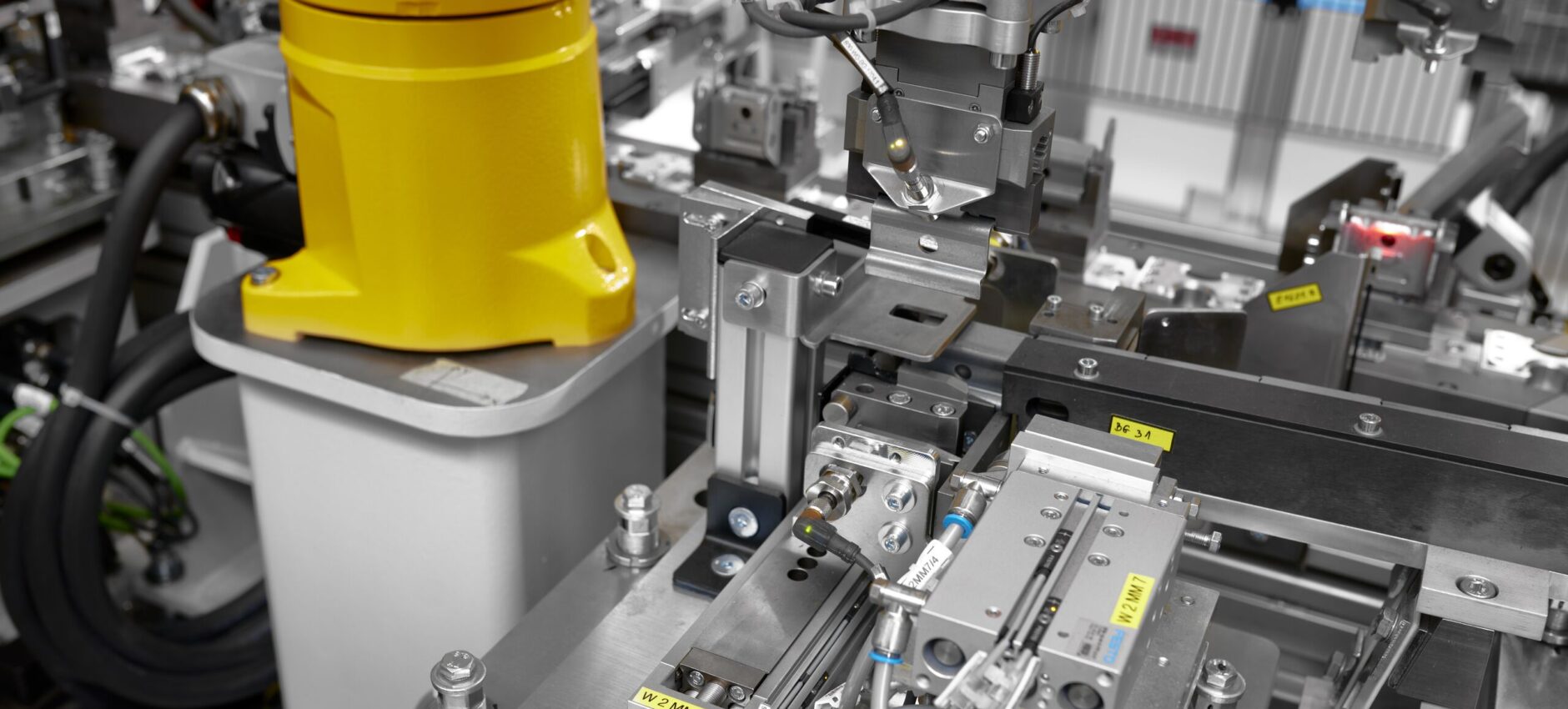
Transfer systems handle the automated transport of components within the manufacturing process. They ensure that workpieces are reliably moved, positioned, and transferred between individual machining steps.
Helmerding transfer technology is based on a customer- and requirements-oriented concept. Modular functional units enable tailored solutions for a wide range of applications and production requirements.
By optimally coordinating the press, transfer technology, and peripheral equipment, high-performance systems are created for safe and cost-effective manufacturing processes.
Part transport within the press can be implemented, among other ways, by:
- floor-mounted transfer units
- overhead transfer units
- gripping and lifting units
- suction cup bridges
- active grippers
- magnetic tooling
- vacuum tooling
This creates flexible solutions for a wide range of forming and manufacturing processes.
Transfer solutions for different requirements
Depending on the application, workpiece, and cycle time, Helmerding develops customized transfer solutions for automated part transport within press and production systems. This includes 2-axis transfers, 3-axis transfers, and feeder systems for loading and repositioning components.

2-axis transfer
2-axis transfers are used when components must be moved precisely and repeatably between individual machining steps.
The systems are designed to match the respective tool and system configuration and enable safe material flow within production.

3-axis transfer
For more complex motion sequences, Helmerding develops 3-axis transfer systems. The additional axis of motion allows workpieces to be transported and positioned flexibly.
The systems are individually matched to component geometry, cycle time, and the production process.

Feeder systems
Feeder systems handle the loading and repositioning of parts within the manufacturing process. They ensure precise workpiece handling and support stable production operation.
Depending on the application, different feeder systems can be integrated and adapted to the requirements of the respective press.
Integration into complete production systems
The basic principle of Helmerding system development is a modular design with defined interfaces. This allows transfer systems to be optimally combined with presses, coil lines, and other peripheral system components.
Possible extensions:
- press systems
- coil lines
- die change systems
- robotics
- automation solutions
This creates end-to-end manufacturing systems with optimally coordinated process sequences.
Frequently asked questions
Helmerding develops 2-axis transfer systems, 3-axis transfer systems, and feeder systems for a wide range of applications within press and production lines.
Depending on the application, floor-mounted or overhead transfer units, gripping and lifting units, suction cup bridges, active grippers, as well as magnetic and vacuum tooling are used.
Yes. Each transfer system is developed according to the respective tooling concept, component geometry, and production requirements.
Yes. Thanks to the modular design, transfer systems can be integrated into both new and existing production systems.
Yes. The systems are designed for integration with presses, coil lines, robotics, and other automation components.
